John Smith - Vancouver Honourees
2026 IG Wealth Management Walk for Alzheimer's, presented by Go Auto
“When she had a day where things weren’t going so well, I’d think – oh, her vertigo is acting up,” says John Smith, whose wife Rae is living with dementia.
Rae was first diagnosed with vertigo in 1999. That ongoing health challenge made a diagnosis of dementia in 2018 that much more surprising. What started as a routine visit to their GP for Rae’s vertigo led to a referral to a gerontologist and then the local emergency room, where the possibility of a dementia diagnosis was first raised.
“Although I suspected something like this, I cried,” says John. “This was something I could not handle alone.”
The next day, he reached out for support, calling the Alzheimer Society of BC and Yukon’s First Link® Dementia Helpline.
"The advice that I got was excellent,” John says of his first call. What began as a phone call grew into a connection with the Alzheimer Society of BC and Yukon that has grown and evolved. John has connected his son and daughter with the First Link® Dementia Helpline and has been an active participant in Alzheimer Society of BC and Yukon support groups and courses for both couples and caregivers.
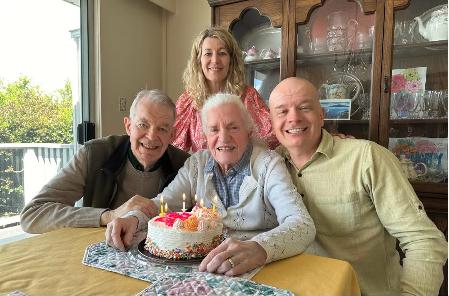
John and Rae have known each other for 80 years – from a neighbourhood playdate at the age of four to being part of the same astronomy club in high school to starting to date in university – and with two children and three grandchildren, their story continues to grow and develop, despite Rae’s diagnosis.
“It’s not what I would have chosen,” John says of their new reality. “I can no longer have a detailed conversation with Rae, but I can do a simple jigsaw puzzle or colour with her and she has a good time. So, I have a good time.”
By sharing and offering advice, John says he has been able to support other care partners affected by dementia, which is one of his proudest moments from the journey. “The dementia journey can be so slow that caregivers often don’t realize the stress they are under,” he says. “I know that was my case.”
He admits that learning to take care of himself as a care partner has not come easily. He uses the example of deciding to seek long-term care for Rae as a difficult but ultimately positive step. Since moving in last summer, Rae now sees the care home as her home, and John can better take care of himself.
“I’ve been able to go out and travel to Toronto and see my granddaughter play field hockey,” he says. “I know Rae is looked after and doesn’t miss me. Every time I see her, she always says, ‘I love you so much and I’m so glad to see you.’”
Still, it’s the moments they share together, and with family, that mean the most.
While John and Rae’s daughter lives in Calgary, she still makes the effort to visit, although the decision is often met with questions like, “Why do you visit your mother when she has no idea who you are?” John explains that although Rae might not recognize her daughter, the two have a special and close connection and that Rae will always smile and comment that a “nice” person is visiting her.
Closer to home, John visits Rae two to three times a week, sometimes staying for supper or bringing his son along to play the guitar. When his son does play, the residents of Rae’s care home come over to listen, and Rae sings along.
“Rae was always musical,” John says. “She was in a choir and the waltz team in high school. So, she’ll know all the words, and it seems like she is back for an hour or so.”
John prioritizes being present for Rae in the moments when she is “back,” but especially in those when she isn’t.
“Continue to be respectful and listen to what they say,” he advises anyone who has a person in their life that is living with dementia. “Never say anything hurtful or contradictory. They are communicating real thoughts and concerns. Be with them in their world, even if it isn’t yours.”
Join John on Sunday, May 31 for the IG Wealth Management Walk for Alzheimer's, presented by Go Auto, in Vancouver.